Teeth Whitening is not one single procedure applied identically to everybody who walks through the door. It is a family of related treatments, each shaped around the kind of staining a person has, the sensitivity they live with, the time they can spare, and the result they actually want at the end of it. Two people can sit in the same chair on the same afternoon and leave having had noticeably different sessions.
The pages that follow set out the Teeth Whitening services we provide, who each one tends to suit, what happens step by step, and — just as importantly — where the honest limits sit. We would rather you arrived already knowing what a treatment can and cannot do than discover it halfway through an appointment.
If you are trying to work out whether any of this applies to you, read the section that matches your situation most closely. You can then look at what results actually look like, check the , and see how we work before deciding anything.
An Overview of Our Teeth Whitening Services
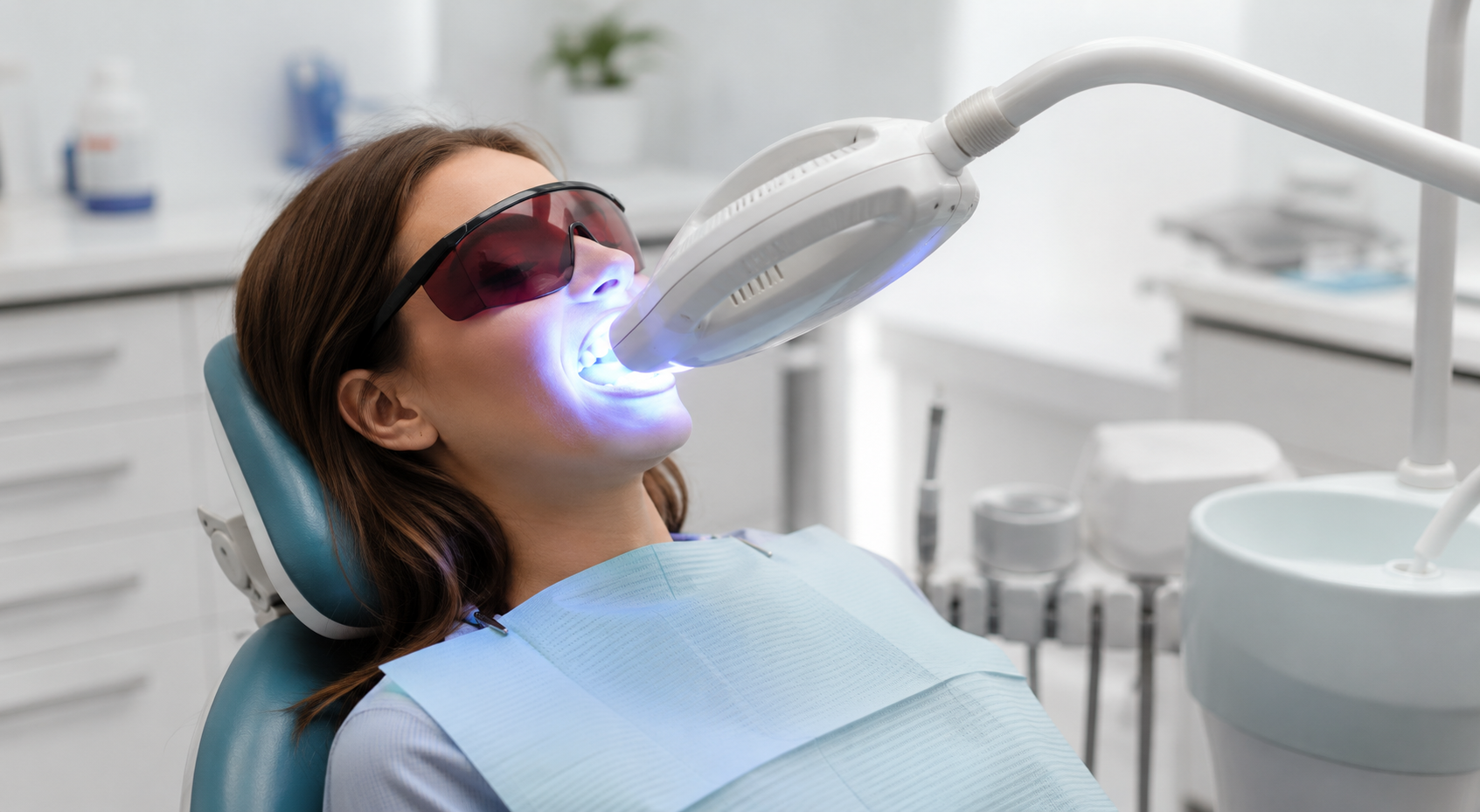
Every Teeth Whitening service we offer rests on the same foundation: an assessment first, a tailored plan second, and treatment only once both of those are settled. That order matters. Whitening is a cosmetic procedure carried out on living tissue, and the difference between a comfortable session with a good outcome and a disappointing one usually traces back to how carefully the groundwork was done. If you are particularly interested in how quickly a visible change can be achieved, it is also useful to understand the factors that influence Fast Teeth Whitening Results, including the type of staining present and the treatment approach selected.
The core treatment is a professional in-chair session lasting roughly sixty minutes, in which a whitening gel is applied to the front surfaces of the teeth and activated using a light or laser unit. Around that core sit several variations: a gentler protocol for people with sensitivity, a longer or repeated protocol for heavier staining, a take-home maintenance option for people who prefer gradual change, and a mobile visit for people who cannot easily reach a clinic.
What none of these services do is change the underlying structure of your teeth. Whitening lifts colour out of the enamel; it does not reshape, straighten, repair, or replace anything. If what is bothering you about your smile is alignment, chipping, gaps, or a failing restoration, whitening will not solve it, and we will say so plainly rather than take a booking that leaves you unhappy.
Assessment First
Every service begins with a consultation in which we look at your teeth and gums, discuss your medical and dental history, identify what kind of staining is present, and record your current shade. Nothing is applied until that is complete.
Tailored Protocol
Gel strength, contact time, number of light cycles, and whether a desensitising agent is used before, during or after treatment are all decided per person. There is no default setting that everybody receives.
Documented Outcome
Your starting shade and finishing shade are both recorded against a standard shade guide so that the change is measured rather than guessed at, and so any future top-up has a reference point.
Teeth Whitening for Younger Adults
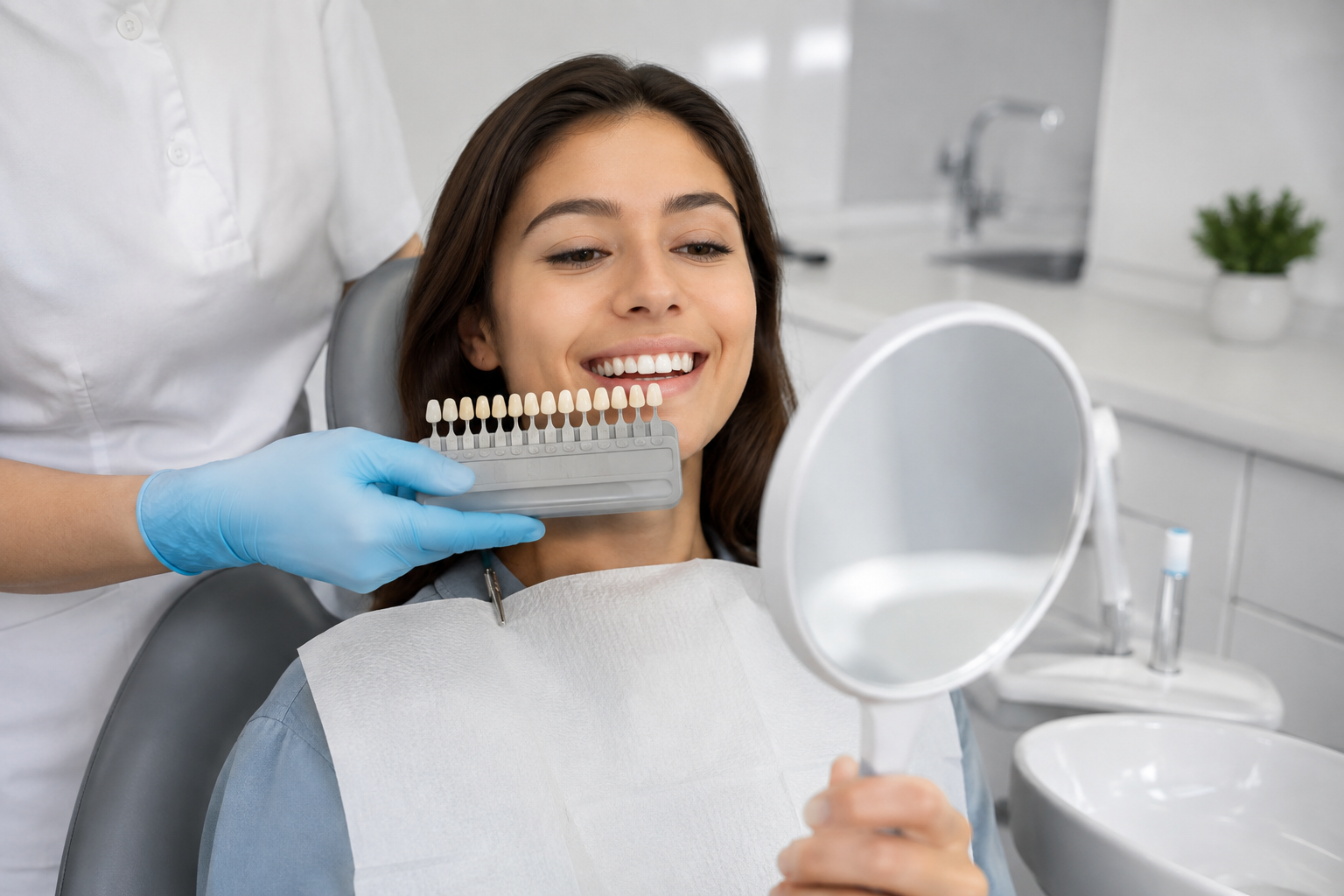
A large share of the people who ask about Teeth Whitening are in their late teens through to their mid-thirties, and their reasons are usually different from those of older clients. They are rarely dealing with decades of accumulated staining. What they tend to have instead is mild, even discolouration that has crept in over a few years of coffee, energy drinks, sports drinks, tea, or a diet heavy in tomato-based and soy-based sauces, combined with a very high exposure to photographs of their own face.
Why younger enamel often responds well
Younger adults frequently see good results, and there is a structural reason for it. Enamel thins gradually across a lifetime. Beneath it sits dentine, which is naturally yellow and becomes more visible as the enamel above it wears. In a younger mouth the enamel layer is usually thicker and the staining that is present tends to be extrinsic — sitting on or just within the outer surface rather than locked deep inside the tooth. Extrinsic staining is exactly what whitening chemistry is designed to address.
The age threshold and why it exists
Cosmetic Teeth Whitening is provided to adults. The reason is not bureaucratic caution. In younger mouths the pulp chamber inside each tooth is proportionally larger and closer to the surface, the enamel is still maturing, and any lingering baby teeth or partially erupted adult teeth create an uneven colour field that whitening will make more obvious rather than less. Waiting until the adult dentition is fully settled produces a better result and a more comfortable session.
What a younger client's appointment usually looks like
Because the staining is often lighter, the consultation focuses heavily on expectation-setting and on identifying habits that will undo the work. We will ask about drinks consumed through the day, whether they are sipped slowly over hours or drunk quickly, whether a straw is ever used, and what the brushing routine actually is rather than what it is supposed to be. Someone nursing a single iced coffee across three hours is giving their enamel far more contact time with pigment than someone who drinks the same cup in ten minutes.
The treatment itself follows the standard structure: shade recording, isolation and gum protection, gel application, light activation in timed cycles, removal, and a final shade check. Where the plan differs is often in aftercare, because a younger client is statistically more likely to return straight to the habits that caused the staining. We spend proportionally more time on maintenance strategy for this group than on the chemistry.
Common motivations
Photographs, job interviews, weddings and graduations, first impressions in client-facing work, and simply disliking the colour drift that has happened gradually enough to be hard to date.
Typical staining
Even, mild yellowing from tea, coffee, cola, energy and sports drinks, and pigmented foods. Usually extrinsic and therefore responsive.
Main risk to manage
Over-treating. A modest lift on already-light teeth looks natural; pushing beyond that adds sensitivity and can look artificial in photographs.
Teeth Whitening for Tea and Coffee Drinkers
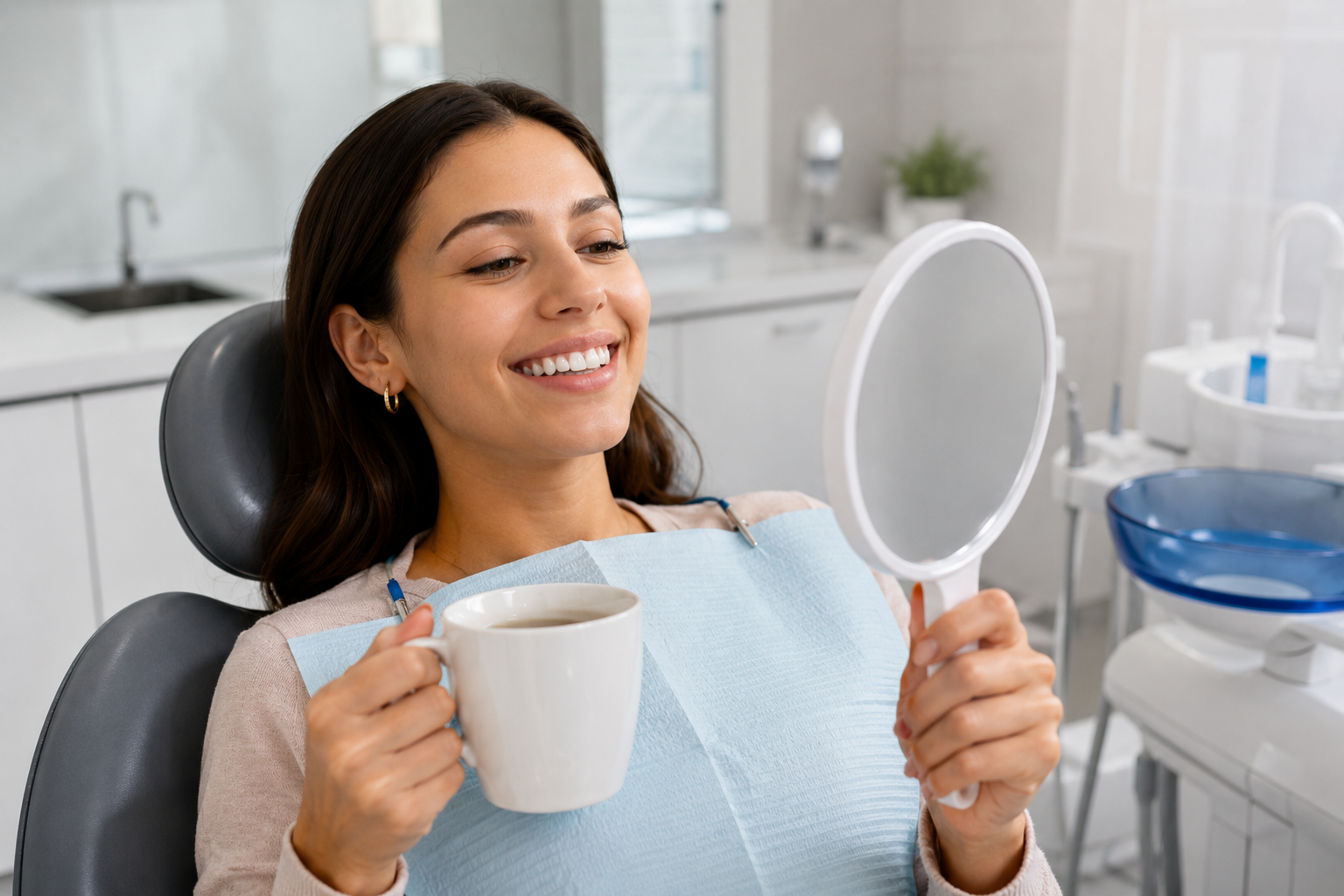
Tea and coffee are the most common single cause of the staining we are asked to treat. The reason sits in a group of compounds called tannins, which occur naturally in both drinks. Tannins are pigmented and they bind readily to the proteins in the thin film that coats your teeth, called the acquired pellicle. Once bound, they are not simply rinsed away. Each cup deposits a little more, and the accumulation is so gradual that most people cannot point to when their teeth changed colour — only that at some point they did.
Why contact time matters more than quantity
People often assume the number of cups is what counts. It matters, but pattern matters more. Four cups drunk quickly at separate points in the day expose the teeth to pigment four times, briefly. One large cup sipped across an entire morning keeps a pigmented, mildly acidic liquid in contact with enamel almost continuously for hours. The second pattern stains considerably more despite involving less liquid.
Temperature and acidity compound this. Hot drinks can cause microscopic expansion in enamel, and the acidity of coffee in particular softens the outer surface temporarily. Pigment introduced during that window has an easier time settling. This is also why brushing immediately after a hot acidic drink is a bad idea — the enamel is at its most vulnerable and abrasion does more harm than the plaque removal does good. Rinsing with water and waiting is the better move.
What Teeth Whitening can realistically achieve here
Tannin staining is the type of discolouration whitening handles best. It is extrinsic, it is organic, and the active whitening agent breaks the pigment molecules apart so they no longer absorb visible light in the same way. Most habitual tea and coffee drinkers see a clear and measurable change, and it is common for the change to be more dramatic than in someone whose teeth were only mildly discoloured to begin with, simply because there was more to remove.
What whitening cannot do is prevent the staining from returning. If nothing about the routine changes, pigment begins accumulating again from the day after treatment. The rate of return is the single biggest determinant of how long a result lasts, and it is almost entirely within the client's control.
Practical adjustments that extend a result
We are not going to tell you to give up coffee. Most people will not, and a recommendation nobody follows is worthless. What does work, and what clients actually adopt, tends to be smaller:
- Drink the cup rather than nursing it. Cutting contact time from ninety minutes to fifteen makes a genuine difference.
- Follow with a mouthful of plain water and swill it briefly. This removes the bulk of residual pigment before it settles.
- Use a straw for iced coffee and iced tea, which routes much of the liquid past the front teeth.
- Wait around thirty minutes after an acidic drink before brushing, so the softened enamel surface has time to remineralise.
- Consider whether a slightly milkier or weaker preparation is acceptable to you. Small dilution changes have a measurable effect over months.
None of this is dramatic. Applied consistently, it is often the difference between a result that fades noticeably within six months and one that still looks good more than a year later.
Teeth Whitening for Sensitive Teeth
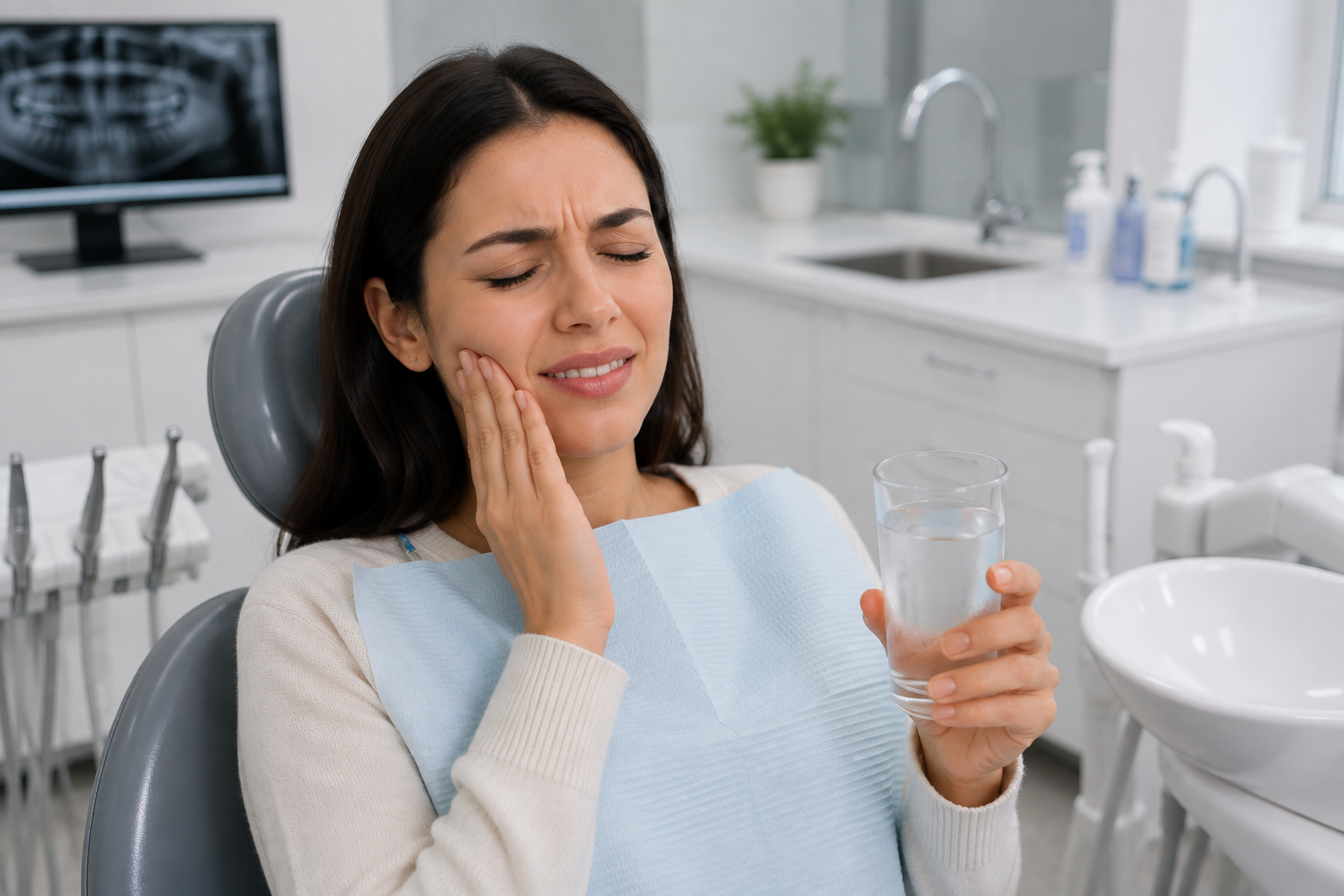
A great many people who would like whiter teeth have quietly decided the treatment is not for them, because they already get a sharp jolt from cold water or something sweet and cannot imagine volunteering for more of the same. That assumption is understandable, and it is also the single most common reason people delay treatment for years. Sensitivity is a reason to adjust how Teeth Whitening is delivered. It is not automatically a reason to rule it out.
What sensitivity actually is
The hard outer enamel covers a softer inner layer called dentine, and dentine is threaded with thousands of microscopic tubules running toward the nerve at the centre of the tooth. When enamel thins, or when gum recession exposes root surface that was never covered by enamel in the first place, those tubules open to the outside world. Fluid inside them shifts in response to temperature, pressure, or osmotic change from something sweet, and that movement registers as a short, sharp pain. It is not damage occurring in the moment; it is a signal travelling along an unusually short path.
Why whitening can trigger it, and what reduces that
The active agent used in whitening moves through enamel and into dentine in order to reach the pigment. In a mouth with open tubules, that transit can provoke exactly the same nerve response as a cold drink. The discomfort is temporary and does not indicate harm, but it is real and there is no reason to simply endure it.
Several adjustments reduce it substantially, and we use them in combination rather than relying on any single one:
- Pre-treatment desensitiser. A desensitising agent applied before the session helps occlude open tubules and calm the nerve response before the whitening gel is introduced at all.
- Lower concentration, longer approach. A gentler formulation working over more cycles reaches a similar endpoint with far less provocation than a single aggressive application.
- Shorter, broken cycles. Splitting contact time into several shorter periods with pauses between them gives the tooth recovery windows.
- Careful gum isolation. A protective barrier keeps the gel off soft tissue and exposed root surfaces, which is where a disproportionate amount of discomfort originates.
- Active monitoring. We check in throughout rather than at the end. If something is uncomfortable we can stop, remove the gel, apply desensitiser, and resume or conclude.
Preparation in the weeks before
Where sensitivity is significant, the most useful work happens before the appointment. Using a desensitising toothpaste containing potassium nitrate or stannous fluoride twice daily for two to three weeks beforehand measurably reduces reactivity during treatment. Switching to a soft-bristled brush and easing off pressure helps, as does avoiding whitening toothpastes with high abrasivity in that window. Cutting back on acidic drinks for a fortnight allows some surface remineralisation.
Where sensitivity is severe, or where it is localised to one or two teeth rather than generalised, that is a signal to investigate rather than to whiten. Sharp pain in a single tooth, pain that lingers for more than a few seconds after the stimulus is removed, or pain that wakes you at night is not ordinary sensitivity and should be assessed by a dentist first. Whitening on top of an undiagnosed crack, cavity, or failing restoration is uncomfortable and unproductive.
What to expect afterwards
Some transient sensitivity in the twenty-four to forty-eight hours after treatment is common and normal, including in people who are not usually sensitive at all. It typically presents as brief zings in response to cold air or cold drinks and settles on its own. Continuing with desensitising toothpaste, avoiding very hot and very cold items for a day or two, and not brushing aggressively all shorten it. Discomfort that is worsening rather than easing after two days should be reported.
Good candidate
Generalised mild-to-moderate sensitivity, no localised sharp pain, no lingering pain, sound enamel and healthy gums. Manageable with a modified protocol.
Needs preparation
Noticeable sensitivity with visible gum recession or enamel wear. Two to three weeks of desensitising preparation before booking gives a far better experience.
Assess before whitening
Sharp pain in one specific tooth, pain lasting beyond a few seconds, night pain, or pain on biting. These need a dental assessment first.
Understanding Which Type of Staining You Have
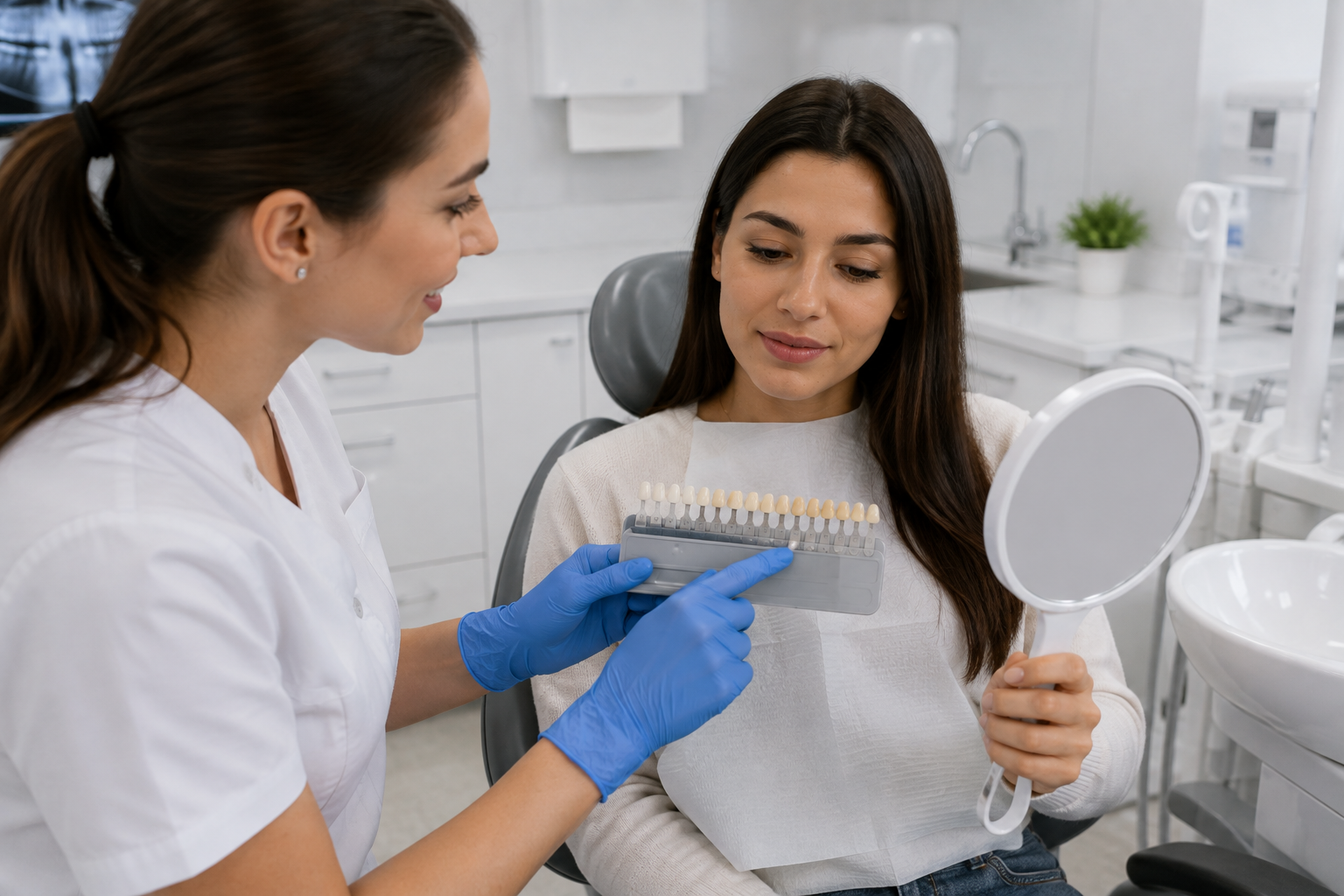
Almost every question about whether Teeth Whitening will work comes down to one thing: what kind of discolouration is present. The chemistry is the same for everybody. What differs is whether the pigment is somewhere the chemistry can reach.
Extrinsic staining
This is surface staining, sitting on the enamel and in its outermost microscopic layers. It comes from tea, coffee, red wine, cola, tobacco, curry and other strongly pigmented foods, and certain mouthwashes. It builds gradually, it is usually fairly even across the visible teeth, and it responds well to whitening. If your teeth have become progressively duller over years of ordinary living, this is almost certainly what you have.
Intrinsic staining
Here the discolouration is inside the tooth structure itself. Causes include certain antibiotics taken while the teeth were forming in childhood, excessive fluoride exposure during development, trauma to a tooth that has affected the pulp, and some developmental conditions affecting enamel formation. Intrinsic staining is often uneven — banding, patches, or a single dark tooth among lighter neighbours. It responds far less predictably to whitening, and in some cases hardly at all. We will tell you if we think this is what we are looking at.
Age-related change
This is not staining in the strict sense. As enamel thins with decades of use, more of the naturally yellow dentine beneath shows through, and the dentine itself darkens slightly over time. Whitening lifts what it can, but it cannot restore enamel thickness. The realistic goal is a fresher, brighter version of your current teeth, not the teeth you had at twenty.
Restorations do not whiten
Crowns, veneers, bridges, composite bonding and tooth-coloured fillings are made from ceramic or resin. Whitening agents have no effect on them whatsoever. If you have restorative work on your front teeth and the natural teeth around it lighten, the restoration will suddenly look darker by comparison because it stayed exactly where it was. This is one of the most important things to identify at consultation, and one of the most common reasons we advise someone that whitening on its own is not the right plan.
| Type | Where the colour sits | Typical cause | Response to whitening |
|---|---|---|---|
| Extrinsic | Enamel surface and outer layers | Tea, coffee, wine, tobacco, pigmented food | Generally good and predictable |
| Intrinsic | Within the tooth structure | Childhood medication, fluorosis, trauma | Limited and unpredictable |
| Age-related | Dentine showing through thinned enamel | Natural wear over decades | Partial; expectations must be realistic |
| Restorations | Ceramic or resin material | Crowns, veneers, bonding, fillings | None — material colour is fixed |
The Consultation: What We Assess Before Anything Is Applied
The consultation is not a formality and it is not a sales conversation. It is the part of the process that determines whether the treatment will work, whether it will be comfortable, and whether it should happen at all. It happens before every Teeth Whitening treatment without exception, including for returning clients, because mouths change between appointments.
Visual examination
We look at the condition of the enamel, the health and position of the gum margin, whether there is visible recession exposing root surface, whether any restorations are present on the visible teeth, and whether there are signs of decay, cracking, or wear. We are not diagnosing dental disease — that is your dentist's role — but we are checking for anything that makes whitening inappropriate right now.
Shade recording
Your current shade is recorded against a standard shade guide, in consistent lighting, before treatment begins. This gives an objective starting point. Without it, "did it work?" becomes a matter of memory and mood rather than measurement. We record the finishing shade the same way.
Agreeing a target
We discuss what you are hoping for, and we are straight about whether it is achievable. If someone arrives wanting a result their staining type will not support, the useful conversation happens now rather than at the end. Equally, if someone wants something subtler than the treatment would naturally produce, we can dial the protocol back. A great many people want less change than they assume, and are happier with a natural result than a startling one.
Reasons we may advise against proceeding
- Untreated decay, active gum disease, or an abscess.
- Significant enamel erosion or exposed dentine across multiple teeth.
- Restorations on the visible teeth where a colour mismatch would be the likely outcome.
- Pregnancy or breastfeeding.
- Very recent dental treatment that has not yet settled.
- Expectations that the treatment cannot meet, where proceeding would mean taking money for a predictable disappointment.
Inside the Session: A Step-by-Step Walkthrough
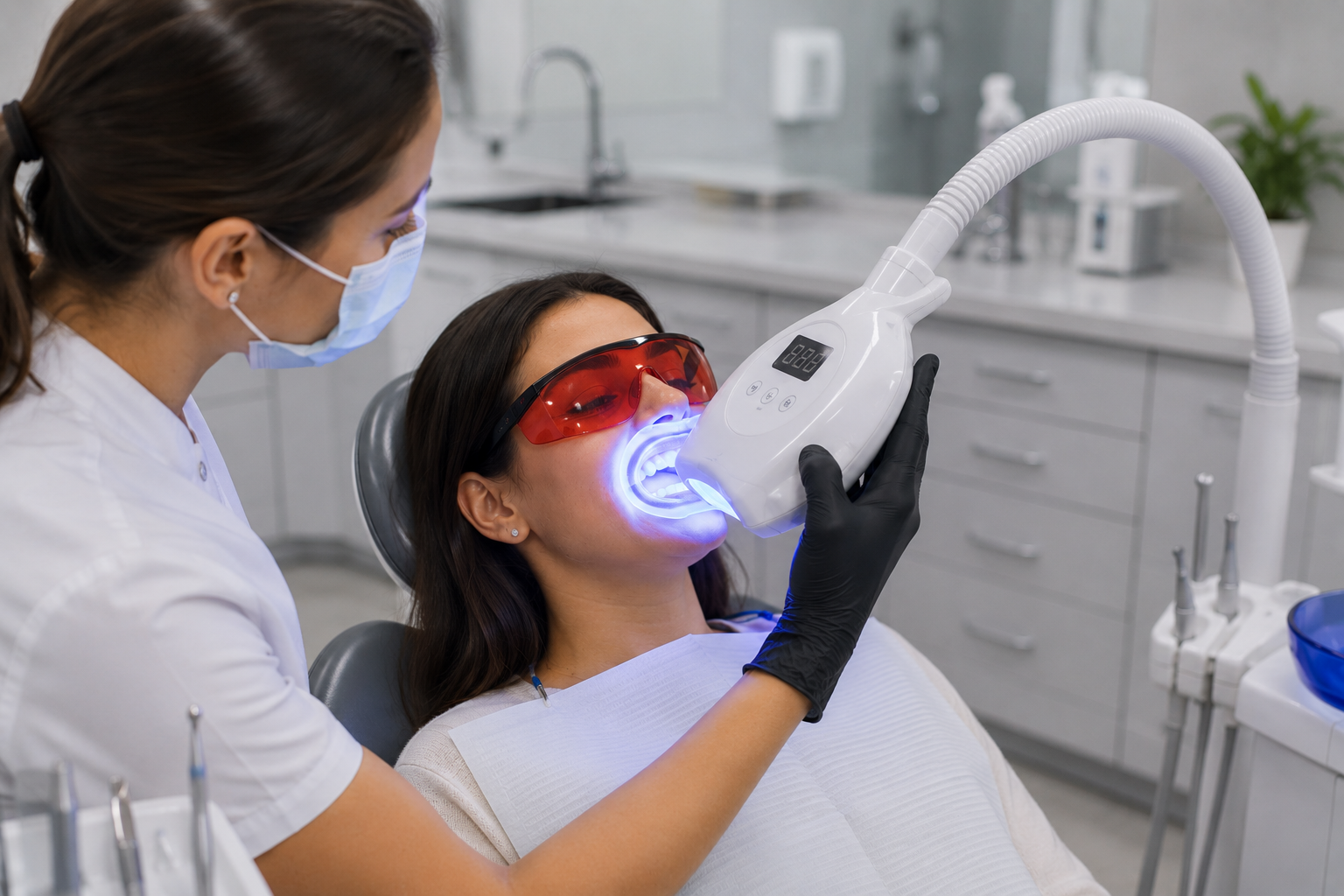
Most people have no clear picture of what an hour of Teeth Whitening actually involves, which makes it harder to decide whether to book. Here is the sequence in order.
Step one: preparation and shade record
You are seated and settled. Your current shade is checked and recorded against the guide. We confirm nothing has changed since consultation — no new sensitivity, no recent dental work, no new medication. This takes a few minutes and is worth doing properly.
Step two: isolation and soft tissue protection
Your lips and cheeks are gently retracted so the front teeth are clearly accessible, and a protective barrier is placed along the gum line. This barrier is the reason whitening gel does not sit against soft tissue, and it is the single most important comfort measure in the whole procedure. It is applied carefully and it takes longer than people expect, because rushing it is what causes gum irritation.
Step three: gel application
The whitening gel is applied in an even layer across the front surfaces of the visible teeth. Only surfaces that show when you smile are treated — the back teeth are not part of a cosmetic whitening treatment and there would be no visible benefit in including them.
Step four: activation cycles
A light or laser unit is positioned in front of the teeth to accelerate the reaction. This runs in timed cycles rather than one continuous stretch. Between cycles the gel may be refreshed and the teeth checked. You can talk between cycles, and you should say so immediately if anything is uncomfortable — there is no benefit whatsoever in enduring it silently.
During the cycles most people feel nothing at all. Some notice a mild tingling. A minority feel occasional brief zings, which is the sensitivity response described earlier and is manageable.
Step five: removal and desensitising
The gel is removed thoroughly, the barrier is taken off, and a desensitising agent is applied. This step is routine rather than reserved for people who complained, because post-treatment sensitivity is easier to prevent than to settle afterwards.
Step six: final shade check and aftercare
The finishing shade is recorded against the same guide in the same lighting so the change is measured rather than impressions compared. We then go through aftercare properly rather than handing over a leaflet, because the first forty-eight hours have a disproportionate effect on how long the result lasts.
How long the whole thing takes
Around sixty minutes for the treatment itself in a straightforward case, with preparation and aftercare discussion around it. A modified protocol for sensitivity may run slightly longer because of the additional pauses. A mobile visit adds setup and pack-down time at either end, but the treatment portion is the same length.
How Treatment Can Be Delivered
The same Teeth Whitening procedure can reach you in three different ways. The choice is about circumstances and preference rather than about clinical quality — the standards do not change between them.
In-Chair Session
The standard option. Professional-strength gel with light activation, carried out in one appointment of roughly an hour. Produces the largest single-visit change and gives us the most control over the process. Suits most people.
Take-Home Maintenance
Custom-fitted trays and a lower-concentration gel used at home over a period of days or weeks. Change accrues gradually. Most useful as a maintenance layer after an in-chair session, or as a gentler route for people with sensitivity who prefer very slow progress.
Mobile Visit
The same clinical procedure delivered at your home. Useful where mobility, childcare, shift patterns, or a straightforward preference for privacy make a clinic visit difficult. Requires a clear, well-lit space and adds setup time either side.
Choosing between them honestly
An in-chair session gives the biggest change in the least time and is the right default for most people. Take-home is slower and demands consistency — trays that sit in a drawer produce nothing — but it gives the user control over pace, which some people with sensitivity strongly prefer. A mobile visit removes travel entirely, which for some people is the difference between having treatment and never getting round to it.
What we would not recommend is starting with take-home in the hope of avoiding an in-chair session where the staining is heavy. Lower-concentration gel over a longer period is not equivalent to professional-strength gel with light activation, and setting out with mismatched expectations tends to end in frustration.
Aftercare and Making the Result Last
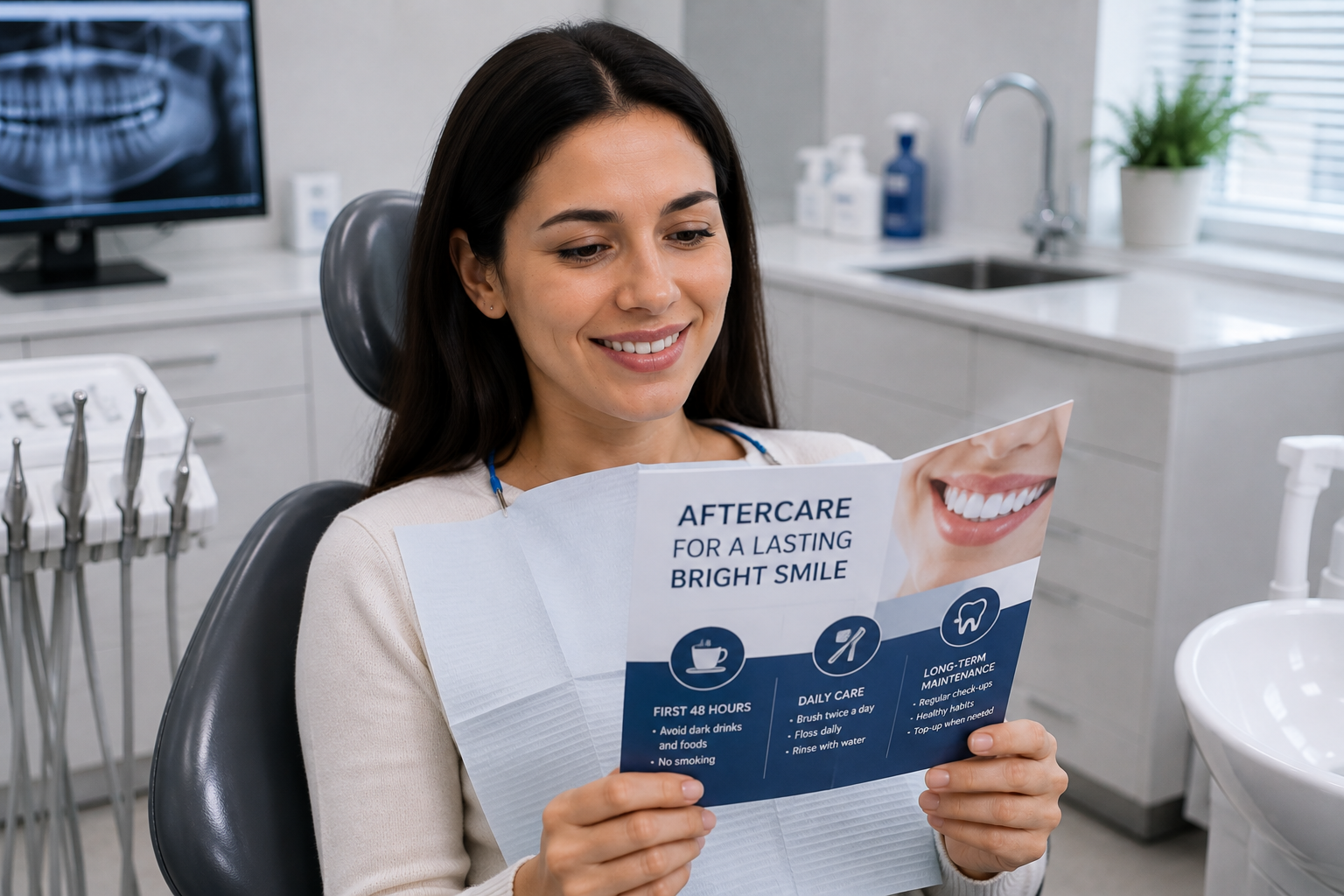
Aftercare is not an afterthought bolted on to the end of the appointment. It is a genuine part of the treatment, and how carefully it is followed in the first two days has a measurable effect on the outcome. For a clearer understanding of what to do after treatment and how to protect your results, see our Teeth Whitening Aftercare guidance.
The first forty-eight hours
Immediately after treatment the enamel is temporarily more porous than usual. This is a normal, transient consequence of the process and it resolves on its own — but during that window your teeth pick up pigment far more readily than they normally would. Introducing a strongly coloured food or drink now can undo a meaningful portion of the change you have just paid for.
For those two days, avoid: coffee, tea, red wine, cola and other dark soft drinks, fruit juices with strong colour, curry and other heavily spiced sauces, tomato-based sauces, soy sauce, balsamic vinegar, beetroot, berries, and any tobacco use. Coloured mouthwashes are worth avoiding too.
Reasonable choices during the window include water, milk, plain yoghurt, white fish, chicken, rice, pasta with a plain or cream-based sauce, potatoes, cauliflower, white bread, and clear soups. It is a short list but it is only forty-eight hours.
Ongoing maintenance
- Brush twice daily with a fluoride toothpaste, using a soft brush and light pressure.
- Clean between the teeth daily. Staining between teeth is invisible until it is significant, and it is the part most people neglect.
- Rinse with water after staining drinks rather than letting residue sit.
- Use a straw for cold pigmented drinks where practical.
- Keep up regular check-ups and hygiene appointments with your own dentist. Professional cleaning removes surface deposits that dull a result.
- Avoid highly abrasive whitening toothpastes used aggressively. They work partly by scrubbing, and over-enthusiastic use thins enamel, which eventually makes teeth look darker rather than lighter.
When to consider a top-up
Results typically hold for somewhere between six months and two years. That range is wide because the variables are behavioural rather than clinical. A heavy smoker who drinks six coffees a day will see change sooner than a non-smoker who mostly drinks water. Noticing gradual fading is not a sign that something went wrong; it is the expected pattern. A top-up session is usually shorter and less involved than a first treatment because it is removing months of accumulation rather than years.
When Teeth Whitening Is Not the Right Answer
An honest services page has to include the situations in which we will tell you not to book, because those situations are common and the alternative is people spending money on something that will not deliver.
Active dental problems
Untreated decay, active gum disease, an abscess, a cracked tooth, or a failing filling all need attention from a dentist before any cosmetic work. Whitening gel reaching an exposed or compromised area is uncomfortable, and treating the surface of a tooth with a problem underneath addresses nothing.
Restorations on the visible teeth
Already covered above, but it bears repeating because it is the single most frequent reason a whitening plan gets redirected. If your front teeth include crowns, veneers, or bonding, whitening the natural teeth around them creates a mismatch. Sometimes the answer is to whiten first and then replace the restoration to match the new shade — but that is a decision to make with your dentist, with the costs understood in advance, not a surprise discovered afterwards.
Intrinsic discolouration
Deep developmental staining, tetracycline banding, or a single dark tooth following trauma will not respond in the way surface staining does. There may be a partial improvement. There may be very little. We would rather explain that clearly than take a booking on the strength of a hope.
Pregnancy and breastfeeding
Elective cosmetic whitening is normally postponed. This is a precautionary position rather than evidence of harm, and it is the standard approach.
Expectations that cannot be met
If someone shows us an image of teeth that are several shades beyond what their starting point and staining type will support, the responsible response is to say so. Setting a target we know we will miss serves nobody.
Common Questions About Our Teeth Whitening Services
Many of the questions people have before Teeth Whitening relate to suitability, sensitivity, expected results, aftercare and the different treatment options available. The answers below cover the most common points, while our Teeth Whitening FAQs provide further information for anyone who wants to explore these questions in more detail.
Start with the consultation. It exists precisely for people who do not yet know which route suits them. We will look at the staining, discuss sensitivity and expectations, and recommend a plan. Nothing is applied at that stage and you are under no obligation to proceed.
Professional whitening carried out to the correct protocol, using products at legally permitted concentrations, with proper gum protection, is not intended to damage enamel. The temporary increase in porosity immediately afterwards is a normal, reversible part of the process. Risk rises with unregulated products used at unknown concentrations without protection, which is one of the main arguments for professional treatment.
The teeth that show when you smile — generally the front eighteen to twenty upper and lower teeth. The exact number varies from person to person depending on the size of the mouth and how much shows when smiling. Back teeth are not treated because there is no visible benefit.
Use a desensitising toothpaste containing potassium nitrate or stannous fluoride twice daily for two to three weeks before your appointment, switch to a soft brush, ease off on pressure, and reduce acidic drinks in that window. Then tell us about it at consultation so the protocol can be adjusted from the start rather than mid-session.
Not unless that is specifically what someone asks for, and we would discuss it carefully first. The intended outcome is a cleaner, brighter version of your own teeth. Where someone wants a subtler change than the standard protocol would give, we reduce it accordingly.
Yes. Tobacco staining is largely extrinsic and often responds well, sometimes dramatically so because there was a lot to remove. The realistic caveat is that continuing to smoke will bring the staining back faster than it would return for a non-smoker. That is information rather than a lecture.
This is why the shade is recorded at both ends and why the target is agreed in advance. If the outcome falls short of what was discussed, we look at why — whether the staining type was more resistant than it appeared, whether a further session is appropriate, or whether the honest answer is that this is what whitening can achieve for your teeth. We would rather have that conversation openly than pretend.
Not Sure Which Service Fits?
Most people are not, and that is exactly what a consultation is for. Have a look at real recorded results, review the full price list, or read how we approach treatment.
When you are ready, the contact page explains how to get in touch and what to have ready.