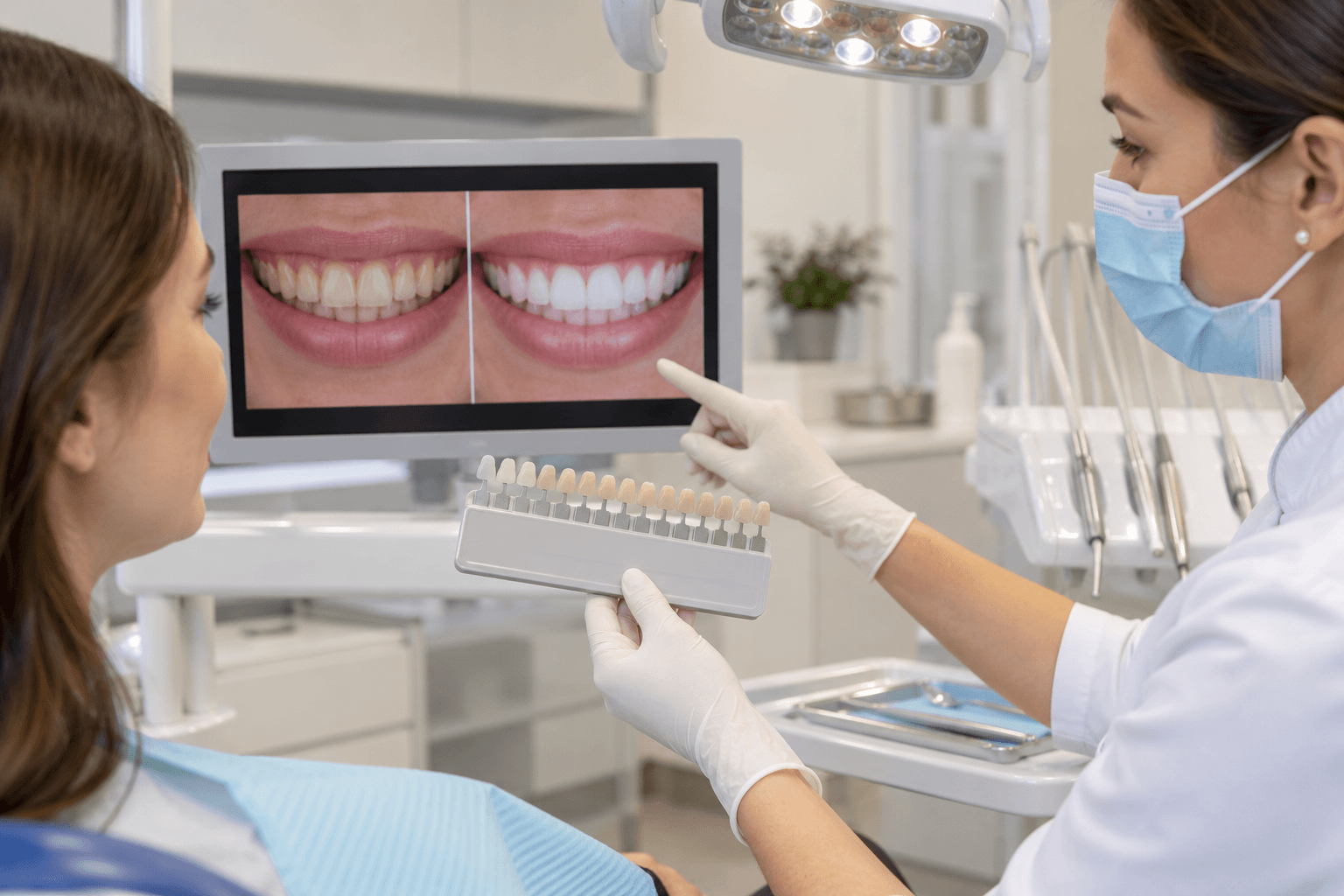
This page is about outcomes: what Teeth Whitening actually achieved for real people, how that change was measured, and why the same treatment produces different numbers for different mouths. Every case set out below is a documented client result, recorded against a standard shade guide rather than described from memory.
We have deliberately included the details that make a result interpretable age, the type of staining involved, and which treatment was used. A shade figure on its own tells you almost nothing. A shade figure alongside the starting point and the staining type tells you a great deal.
Read this page alongside the services that produced these outcomes. If you are researching Professional teeth whitening in Nottingham, reviewing the treatment options alongside documented results can help you understand how professional whitening is approached and why outcomes differ between individuals. The two together will give you a much more accurate sense of what may be achievable for you than either would alone.
How a Teeth Whitening Result Is Measured
When someone says their teeth went "a few shades lighter", that phrase has a specific technical meaning rather than being a figure of speech. Tooth colour is assessed against a standardised shade guide a physical set of reference tabs arranged from the lightest to the darkest, held against the tooth in consistent lighting so that a judgement is made by comparison rather than by impression.
A shade is recorded before treatment begins and again once the treatment is complete. The difference between those two positions on the guide is the shade change. That is what a figure like "seven shades lighter" refers to: a movement of seven positions along a standard reference scale, not a subjective sense that the teeth look better.
Why measurement matters more than it sounds
Memory is unreliable about colour. People adapt to a change within days and genuinely forget what their teeth looked like beforehand, which is why some clients become uncertain about whether much happened at all a week later. Others are convinced of a dramatic transformation that the guide does not support. Recording at both ends removes the argument entirely.
It also gives a reference point for the future. If someone returns eighteen months later, we know precisely where they started and where they finished the first time, which makes it much easier to judge what a maintenance session should aim for.
What a shade number does not tell you
A large shade change is not automatically a better outcome than a small one. Someone with heavy tobacco and red wine staining has a long way to travel and may move a great many positions on the guide; someone whose teeth were already fairly light may move only a few, and end up whiter in absolute terms than the person with the bigger number. Both can be excellent results. Comparing your own likely change to somebody else's headline figure is one of the most common ways people set themselves up for disappointment.
Lighting also matters enormously. Teeth look different under daylight, warm domestic bulbs, and clinical lighting. This is why shade recording is done in consistent conditions at both ends of the treatment, and why comparing a photograph taken in your bathroom against one taken in a clinic tells you very little.
Recorded Result: Derick, Age 75 — Sutton, Surrey
Recorded shade change: 9 shades lighter. Treatment: one-hour laser session combined with a home maintenance whitening kit. Staining present: tobacco, coffee, red wine, and general food staining.
What this case involved
Derick is a former cigarette smoker and a committed coffee drinker, and by the time he came in he had accumulated the full combination of staining that a long life produces: tobacco residue, tannin from years of coffee, pigment from red wine, and general dietary staining layered on top. Each of those alone discolours teeth. Together they compound.
He was also entirely realistic about the underlying situation, which made the consultation straightforward. He understood that enamel thins with age and that some of the change in his teeth was structural rather than staining — the natural yellow of dentine showing through a thinner outer layer. That understanding is unusual and it matters, because it meant the target we agreed was one the treatment could actually reach.
Who a case like this may suit
Older clients with decades of layered extrinsic staining frequently produce the largest shade movements, precisely because there is so much to remove. If you are in your sixties, seventies or beyond and have assumed you have left it too late, this case is the counter-argument. Age is not in itself a barrier to Teeth Whitening. What matters is the condition of the enamel and gums, and whether the discolouration is surface accumulation or structural change.
The factors that produced this outcome
- Heavy extrinsic staining. Tobacco, coffee and red wine deposits sit largely on and within the outer enamel, which is where whitening chemistry is effective.
- Sound enamel and gum condition. Without that, the protocol would have had to be scaled back regardless of how much staining was present.
- A combined approach. The in-chair laser session did the substantive work; the home maintenance kit extended and held it.
- Realistic expectations agreed in advance. The target was set against what the enamel could support, not against an image of somebody else's teeth.
Responsible use of a result like this
A nine-shade change is a large movement and it is tempting to read it as a promise. It is not. It is what happened for one person with a particular combination of staining and a particular enamel condition. The responsible way to use this case is as evidence that heavy long-accumulated staining is treatable, not as a figure to expect.
The home maintenance element also carries a responsibility. A take-home kit works when it is used as directed and at the intervals agreed. Using it more often or for longer than instructed in the hope of pushing further does not accelerate anything useful and increases the likelihood of sensitivity and gum irritation.
Lifestyle compatibility
Derick's habits are exactly the habits that caused the staining, and they had not all disappeared. That is the ordinary situation rather than the exception. Where coffee and wine remain part of daily life, the result will fade faster than it would for someone who drinks mostly water, and a maintenance layer becomes the practical answer rather than an upsell. The combination used here — an in-chair session plus home maintenance — is well suited to precisely that pattern.
Recorded Result: Jane Anderson, Age 28 — South West London
Recorded shade change: 7 shades lighter. Treatment: one-hour power laser treatment. Staining present: smoking, coffee, and general lifestyle staining.
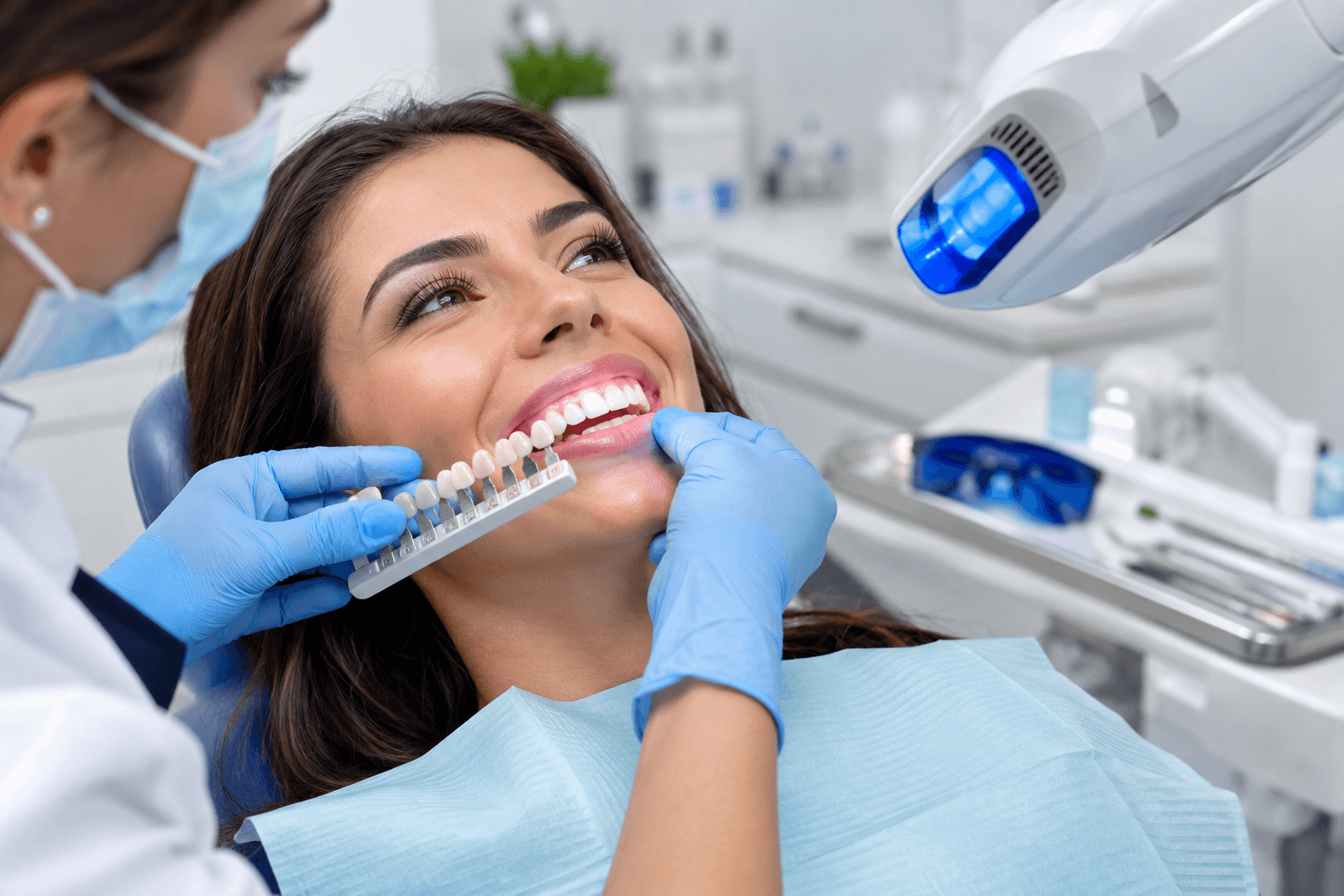
What this case involved
Jane is nearly fifty years younger than Derick and arrived with a different profile: less total accumulation, but a concentrated combination of smoking and coffee over a shorter period. Tobacco staining in a younger mouth tends to sit fairly superficially and can respond quickly, which is part of why a single session without a take-home component was appropriate here.
Her enamel had not yet undergone the age-related thinning that shapes older cases, so a greater proportion of what was visible was genuine surface staining rather than dentine showing through. That distinction is the main reason two people can have quite different starting appearances and reach similar endpoints.
Who a case like this may suit
Adults in their twenties and thirties who smoke, or who have smoked, and who drink coffee regularly. This is one of the most common presentations we see, and it is one of the more responsive. If you have been avoiding treatment because you assume smoking rules you out, it does not — although it does affect how long the result will hold.
The factors that produced this outcome
- Predominantly extrinsic staining. Tar and tannin deposits, not developmental discolouration.
- Relatively intact enamel. Less age-related thinning meant more of the visible colour was removable.
- A single concentrated session. Where staining is responsive, a well-executed one-hour treatment can do the whole job.
- No restorations complicating the visible teeth. Nothing that would lighten at a different rate to everything around it.
Responsible use of a result like this
The important caveat with tobacco staining is honesty about what happens next. Whitening removes the deposits present on the day; it does nothing to prevent new deposits. Someone who continues smoking at the same rate will see the result fade faster than a non-smoker, and it is better to know that in advance than to feel let down at six months.
Equally, a fast dramatic change should not be read as an invitation to repeat the treatment frequently. Whitening sessions are spaced deliberately. Stacking them in pursuit of a bigger number is not how the treatment is designed to be used.
Lifestyle compatibility
This result suits someone whose routine will continue to generate staining but who wants a clear reset now — before an event, a new job, or simply because the accumulation had become noticeable. A single session fits a busy schedule, and the aftercare demands are limited to the first forty-eight hours plus ordinary oral hygiene thereafter. Where smoking continues, planning for periodic maintenance is the realistic approach.
Recorded Result: Christine, Age 20 — London
Recorded shade change: 6 shades lighter. Treatment: one-hour power laser treatment. Staining present: general staining, presenting as diffused yellowing across the canines and front incisors.
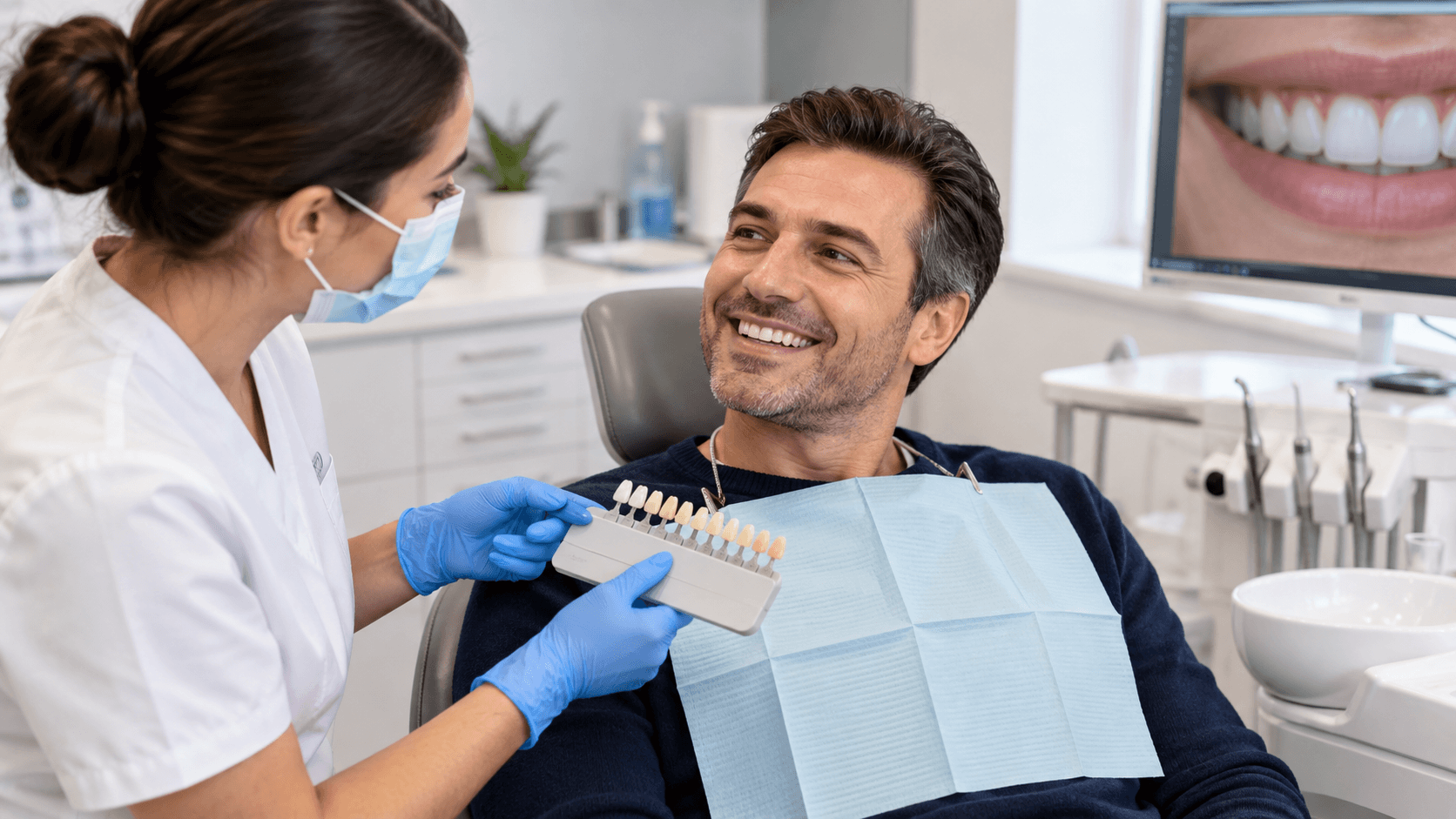
What this case involved
Christine's case is the most instructive of the four for younger readers, because the presenting problem was not heavy staining at all. It was diffused yellowing concentrated on the canines and the front incisors — a very common pattern, and one that bothers people disproportionately because those are precisely the teeth that show most when speaking and smiling.
Canines are naturally slightly more yellow than the incisors beside them in most people, because they are bulkier teeth with proportionally more dentine beneath the enamel. When general yellowing is added on top, the contrast between canine and incisor becomes more obvious and the whole smile reads as duller than it is. Part of what treatment achieved here was evening out that relationship as well as lifting the overall shade.
Who a case like this may suit
Younger adults with mild, even discolouration rather than dramatic staining. The frustration in this group is often that the problem is hard to articulate — nothing looks obviously wrong, but photographs consistently disappoint. A six-shade movement on already-light teeth produces a noticeable change without tipping into anything artificial.
The factors that produced this outcome
- Young, relatively thick enamel. Less dentine showing through, so more of the visible colour was addressable.
- Diffuse rather than patchy discolouration. Even staining lightens evenly; blotchy staining can lighten unevenly.
- A moderate target. The aim was a balanced, natural-looking improvement, not the largest possible number.
- Attention to the canine-to-incisor relationship. Adjusting the overall colour so the smile reads as consistent rather than simply lighter.
Responsible use of a result like this
The main risk in this group is over-treatment. When the starting point is already light, there is a strong temptation to push for more, and beyond a certain point additional treatment adds sensitivity rather than visible improvement. It can also produce a flat, uniform brightness that photographs poorly and looks less natural than the result it replaced. Knowing when to stop is a genuine part of doing this well.
Lifestyle compatibility
A single session with no take-home component suits someone whose staining accrues slowly. For a younger client without heavy tobacco or coffee exposure, a result like this can hold for a considerable time with nothing more than ordinary brushing, interdental cleaning, and sensible rinsing after pigmented drinks. This is the group least likely to need a maintenance layer and most likely to be told they do not need one.
Recorded Result: Patricia, Age 32 — Crystal Palace
Recorded shade change: 8 shades lighter. Treatment: one-hour power laser treatment. Staining present: general lifestyle staining. Noted at the time by the treating whitening specialist as producing an end result lighter than the reference shade guide used for comparison — among the whitest outcomes they had recorded.
What this case involved
Patricia presented with general lifestyle staining rather than any single dominant cause — the cumulative effect of ordinary diet, drinks, and time. What made the case notable was not the staining but the response: the finishing shade sat beyond the lightest tab on the guide being used, which means the change could not be fully expressed as a number on that scale.
Outcomes at that end of the range are uncommon and they are not predictable in advance. They depend on the individual optical properties of the enamel — its thickness, translucency, and mineral structure — which vary from person to person for reasons that have nothing to do with how the treatment is carried out.
Who a case like this may suit
Adults in their thirties with accumulated general staining and sound enamel. That is a broad description covering a very large number of people, which is exactly the point: this was not an exotic case. It was an ordinary presentation that happened to respond exceptionally well.
The factors that produced this outcome
- Highly responsive enamel. The dominant factor, and the one nobody can control or predict.
- General extrinsic staining. No developmental or intrinsic component to limit the response.
- Good baseline oral condition. Healthy gums and intact enamel allowed the full protocol to be used.
- Standard one-hour protocol. Nothing unusual was done; the treatment was the same one used in the other cases.
Responsible use of a result like this
This is the case most likely to be misread, so it deserves the plainest warning on the page. An exceptional outcome is exceptional. Presenting it as a benchmark would be misleading, and expecting it would be setting yourself up to be disappointed by a perfectly good result. It is included because it is documented and real, not because it is representative.
There is also a point about restraint. When teeth respond this readily, the sensible course is to stop at a natural-looking endpoint rather than continue simply because the enamel is cooperating.
Lifestyle compatibility
General lifestyle staining accumulates steadily, which means a result at this level will drift back over time like any other. Someone with a very light finishing shade often notices the return of dullness sooner, because there is a greater distance between where the teeth are and where they naturally sit. Consistent aftercare matters more here rather than less.
Before and After Records
Photographic records are kept alongside shade measurements. The placeholders below hold the positions where those before-and-after comparisons appear, at the correct proportions so the layout is identical once the real images are added.
How to read a before-and-after photograph critically
Comparison photographs are useful, but only if they are read carefully. There are several ways a pair of images can exaggerate a change without anyone deliberately manipulating anything:
- Lighting. A warmer light on the "before" and a cooler light on the "after" will shift apparent tooth colour substantially with no treatment involved at all.
- Lip retraction. Teeth photographed with the lips held back look different from teeth photographed in a natural smile, because more surface and a different angle are visible.
- Surrounding colour. Skin tone, lipstick and clothing all affect how white teeth appear by contrast. This is a genuine perceptual effect, not a trick.
- Camera settings. White balance, exposure and saturation change apparent shade dramatically between two images of the same teeth.
- Angle and focus. A slight change of angle alters which surfaces catch the light.
This is precisely why shade guide measurement sits at the centre of how results are recorded here, and why photographs are treated as supporting evidence rather than as the measurement itself. A number taken against a physical reference in consistent lighting is not subject to any of the above.
Which Teeth Are Treated
One detail that is often unclear until someone asks: laser Teeth Whitening treats the teeth that are visible when you smile — generally the front eighteen to twenty upper and lower teeth. The precise number varies from person to person depending on the size of the mouth cavity and how much of the dentition shows on a full smile.
Back teeth are not included. There would be no visible benefit, and treating surfaces nobody sees adds contact time and sensitivity for no cosmetic return. If you are comparing what different treatments cover, this is worth understanding rather than assuming that a whitening treatment addresses every tooth in the mouth.
It also explains something people occasionally notice afterwards: if you have a very wide smile and your rearmost visible teeth sit at the edge of the treated zone, there can be a subtle gradient toward the back. In practice this is rarely noticeable in normal conversation, but it is honest to mention it.
Why Results Vary Between People
The four cases above used closely related treatments and produced changes of six, seven, eight and nine shades. That spread is normal and it is not a reflection of inconsistency. Several independent variables determine where any individual lands.
Starting shade
Darker teeth have more distance to travel and often record larger movements. Lighter teeth record smaller numbers while sometimes finishing lighter in absolute terms.
Type of staining
Extrinsic surface staining responds well. Intrinsic discolouration within the tooth structure responds far less predictably, and sometimes barely at all.
Enamel thickness and porosity
Varies between individuals and thins with age. Thicker, more porous enamel generally allows a fuller response.
Age
Not a barrier, but relevant. Older teeth often carry more removable staining alongside more structural darkening that whitening cannot address.
Existing restorations
Crowns, veneers, bonding and tooth-coloured fillings do not lighten. Their presence on visible teeth shapes what a sensible target looks like.
Sensitivity
Where a gentler protocol is needed for comfort, the endpoint may be more moderate. That is a deliberate trade and the right one.
The variable nobody can measure in advance
Beyond all of the above, individual enamel simply responds differently for reasons that are not visible at consultation. Two people with apparently identical starting points and identical staining can finish at different places. This is why an honest consultation gives a likely range rather than a guaranteed figure, and why anyone promising a precise outcome before treatment is overstating what can be known.
How Long Results Last
Results commonly hold somewhere between six months and two years. The width of that range is not vagueness — it reflects the fact that the dominant variables are behavioural rather than clinical.
What shortens a result
Continued smoking, several coffees or teas a day, regular red wine, frequent dark soft drinks, and diets heavy in strongly pigmented sauces can all shorten how long a whitening result remains visible. People concerned specifically about staining from these everyday drinks can also read our guidance for Tea Coffee Drinkers Nottingham to understand how regular tea and coffee consumption can affect tooth colour and whitening maintenance
What extends a result
Careful adherence to the forty-eight-hour aftercare window immediately after treatment, rinsing with water after pigmented drinks, using a straw for cold drinks where practical, daily interdental cleaning, regular professional hygiene appointments, and where appropriate a maintenance layer used at the agreed intervals rather than improvised.
Fading is expected, not a fault
Teeth do not stay at their post-treatment shade permanently, and no professional treatment claims otherwise. Gradual return of dullness over months is the normal pattern and does not indicate that anything went wrong. A top-up session is generally shorter and less involved than an initial treatment, because it is clearing months of accumulation rather than years.
What Happens to the Shade in the Days After Treatment
The number recorded at the end of a session is not quite the final number, and understanding why prevents a good deal of unnecessary worry in the week that follows.
The immediate appearance is slightly misleading
During treatment the enamel becomes temporarily dehydrated. Dehydrated enamel appears lighter and more opaque than fully hydrated enamel, which means the teeth you see in the mirror immediately afterwards are showing you a slightly flattered version of the outcome. Over the following day or so the enamel rehydrates and some of that extra brightness recedes.
This is entirely normal and it is not the result fading. People who are not told about it sometimes conclude on day two that the treatment has already stopped working, when what they are actually seeing is the true result emerging from behind a temporary optical effect. We record the finishing shade knowing this, and we describe the expected settling so nobody is caught out by it.
Why the first week is the honest test
By roughly seven days the enamel has fully rehydrated and the shade has stabilised. That is the point at which the outcome should be judged, and it is the point at which a decision about whether any further treatment is worthwhile can sensibly be made. Judging on the day of treatment tends to overstate the result; judging on day two tends to understate it.
Uneven appearance in the first days
Some people notice temporary patchiness or a few brighter spots in the first day or two. This usually reflects uneven dehydration across the tooth surface rather than uneven whitening, and it evens out as the enamel rehydrates. Persistent patchiness after a week is a different matter and worth mentioning, particularly where there may be underlying developmental variation in the enamel that was not obvious before the surrounding staining was removed.
Why we do not photograph the final result on the day
For the same reason. An image captured while the enamel is dehydrated flatters the outcome, and a comparison built on that image is not an honest one. Records taken once the shade has settled are less dramatic and considerably more useful.
How These Results Compare With Home Whitening Kits
Almost everyone considering Teeth Whitening has already looked at, or tried, something bought from a shop or online. It is a reasonable thing to have done, and it is worth being clear about why the outcomes recorded on this page differ from what those products typically produce.
Concentration and supervision
Professional treatment uses products at concentrations that are legally restricted to supervised application, delivered by someone who has assessed the mouth first and who protects the soft tissue before anything is applied. Home products available for unsupervised purchase are necessarily formulated at much lower active concentrations, because they are designed to be safe when used without any assessment at all. Lower concentration means a smaller change per application, which is a deliberate design constraint rather than a defect.
Fit and contact
A generic one-size tray cannot hold gel evenly against every tooth surface in a mouth it was not made for. Gel pools in some places, thins in others, and escapes onto the gums where it causes irritation without contributing anything. Custom trays made from an impression of your own teeth address this, which is why the take-home component of a professional plan behaves differently from an off-the-shelf kit even at comparable gel strengths.
Assessment before application
This is the difference that matters most and it has nothing to do with chemistry. Nobody checks a home kit user for untreated decay, gum recession, exposed dentine, or a failing restoration on a front tooth. A user with any of those will get an uncomfortable experience and a poor outcome, and will often conclude that whitening does not work for them when the real issue was that it should not have started yet.
Abrasive products are not whitening at all
A significant portion of what is marketed as whitening — charcoal preparations, high-abrasivity pastes, various scrubs — does not lighten the tooth chemically. It removes surface deposits by physical abrasion. That can produce a modest short-term improvement, and it also removes a little enamel each time. Because enamel does not regrow and thinner enamel shows more of the yellow dentine beneath, sustained use of aggressive abrasives makes teeth darker over a period of years while appearing to help in the short term.
The reasonable conclusion
Home products are not useless. Used sensibly, a low-concentration product can help maintain a result that already exists. What they generally cannot do is produce the size of change recorded in the cases above, and it would be misleading to suggest otherwise. Someone with a nine-shade problem is not going to solve it with a supermarket kit, and someone with mild surface dullness may not need a clinic at all.
Responsible Use of Teeth Whitening Treatment
Teeth Whitening is a cosmetic procedure performed on living tissue, and it should be used in the way it is designed to be used. The following applies to every case on this page.
Follow the agreed interval between treatments
Sessions are spaced deliberately. Teeth benefit from a recovery period, and the final shade continues to settle for a short time after treatment, which means judging the outcome immediately can be misleading. Booking additional sessions in rapid succession in pursuit of a larger number is not how the treatment is intended to work and increases the likelihood of sensitivity without a proportionate gain.
Use take-home products exactly as directed
Where a home maintenance kit forms part of a plan, the instructions on frequency, duration and quantity exist for a reason. Extending wear time, applying more gel than directed, or using the kit more often than agreed does not accelerate the result. It raises the risk of gum irritation and sensitivity.
Do not layer unregulated products on top
Combining a professional treatment with over-the-counter or online whitening products of unknown concentration is a common and avoidable mistake. You cannot judge cumulative exposure when you do not know what is in the second product, and gum protection is generally absent from home use.
Report anything that is not settling
Short-lived sensitivity in the first day or two is expected. Discomfort that is worsening after forty-eight hours, gum soreness that is not resolving, or pain localised to one specific tooth should be reported rather than waited out. These are not typical and they warrant a look.
Keep up your ordinary dental care
Whitening is cosmetic. It is not a substitute for regular check-ups, hygiene appointments, or treatment of any dental problem. Your dentist remains responsible for your dental health, and cosmetic whitening sits alongside that care rather than replacing any part of it.
Stop at a natural endpoint
The best results on this page are the ones that look like the person's own teeth on a good day. Pushing past a natural endpoint adds sensitivity and, beyond a point, looks worse rather than better in photographs and in person.
Wellbeing Disclaimer
The results described on this page are individual outcomes recorded for specific clients. They are provided for information and are not a prediction or guarantee of what any other person will achieve. Teeth Whitening results vary according to starting shade, the type and depth of discolouration present, enamel thickness and condition, age, existing dental work, and lifestyle. Two people receiving the same treatment may reach different endpoints.
Nothing on this page is dental or medical advice, and nothing here is a diagnosis. Teeth Whitening is a cosmetic procedure. It does not treat decay, gum disease, cracks, infection, sensitivity arising from an underlying problem, or any other dental condition, and it should never be used as a substitute for assessment and treatment by a qualified dental professional.
Teeth Whitening is not suitable for everyone. It is generally inappropriate where there is untreated decay, active gum disease, significant enamel erosion or exposed dentine, an unresolved dental problem, or during pregnancy and breastfeeding. Where restorative work is present on the visible teeth, whitening will not change the colour of that material and a mismatch may result. Suitability is assessed individually before any treatment, and there are circumstances in which the appropriate advice is not to proceed.
Temporary sensitivity is a recognised and common effect of whitening. It usually presents as brief discomfort in response to hot or cold and typically settles within a day or two. If you have existing dental concerns, ongoing sensitivity, or any relevant medical condition, discuss them with your own dentist before considering cosmetic whitening.